Arachis hypogaea · Fabaceae
Peanut: the plant whose leaves close for the night
Goober, pindar, monkey nut, groundnut: one South American legume with four-part leaves that close at night and thousands of local forms.
3 min read · Reviewed · 1 reference
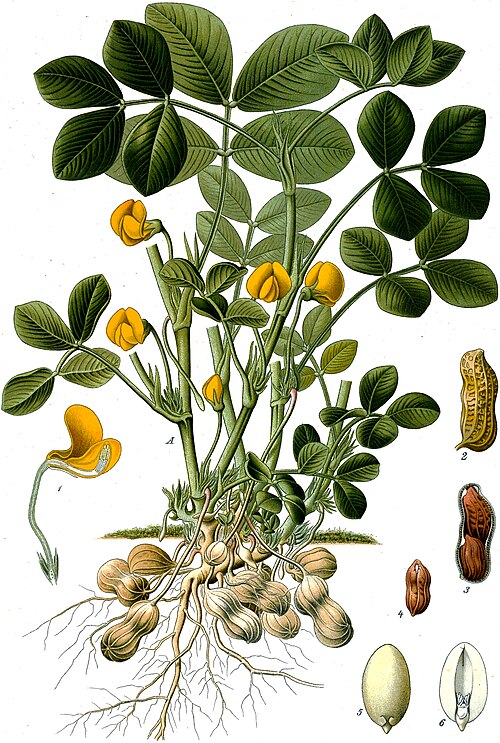
Goober, pindar, monkey nut
Arachis hypogaea answers to many names in English. Peanut and groundnut are two of them. In the United States it is also the goober or goober pea and the pindar, and both goober and pindar came by way of Kikongo. In the United Kingdom it is the monkey nut. Carl Linnaeus described the species in 1753 in his Species Plantarum.[1]
The plant belongs to the Fabaceae, known as the legume, bean or pea family, and its pods are technically legumes. Botanically they are not nuts, a nut being a fruit whose ovary wall turns hard at maturity. The shell of a peanut consists mainly of a mesocarp, and several large veins run along its length.[1]
Leaves that sleep
The leaves grow opposite each other, and each is divided into four leaflets: two opposite pairs, with no leaflet at the tip. A leaflet is 1 to 7 cm long and 1 to 3 cm across. As in many other legumes the leaves are nyctinastic, which means that they make 'sleep' movements and close at night.[1]
The flowers are 1 to 1.5 cm across and are carried in clusters in the leaf axils along the stems. The plant goes on producing them while its earlier pods are developing.[1]
A wild form in a few limited places
The peanut has a wild form, Arachis monticola. It occurs in a few limited places in the northwest of Argentina, or in the southeast of Bolivia, where farmers today grow the landraces that look most like wild plants.[1]
From this center of origin cultivation spread, and secondary and tertiary centers of diversity formed in Peru, Ecuador, Brazil, Paraguay and Uruguay. Many pre-Columbian cultures showed peanuts in their art, the Moche among them.[1]
Two subspecies, thousands of landraces
Over time thousands of landraces evolved. They are classified into two subspecies and six botanical varieties. Plants of subspecies fastigiata grow more upright and have shorter crop cycles, with harvest usually 90 to 130 days after planting. Plants of subspecies hypogaea spread more over the ground and take longer, usually 120 to 150 days, depending on the cultivar and on growing conditions.[1]
The market has classes of its own. American growers raise four: Spanish, Runner, Virginia and Valencia. The small Spanish types, which have a higher oil content than other peanuts, are also grown in South Africa. Until 1940 they made up 90% of the crop in the U.S. state of Georgia; the trend since then has been toward cultivars with larger seeds, higher yields and more resistance to disease.[1]
Drought, pests and an allergy
A peanut crop can get by on as little as 350 mm of water, though the best yields need at least 500 mm. In semi-arid regions drought and high-temperature stress are the main limits on yield. The plant is particularly sensitive to them just before flowering, at flowering and when its pods begin to develop.[1]
Among insect pests, pod borers, aphids and mites matter. Leaf spots, rusts and the toxin-producing fungus Aspergillus are the most important diseases, and another fungus, Alternaria arachidis, can affect the leaves.[1]
The peanut is itself a danger to some of the people who meet it. Between 1.4 and 2% of people in Europe and the United States have allergic reactions to peanut exposure, and a reaction can be fatal.[1]
More than a seed
People use more of the plant than its seeds. The tops go into silage, and the fiber-rich hulls removed in industrial processing can feed livestock, ruminants in particular. Industrial uses of peanut oil include paint, varnish and furniture polish.[1]
George Washington Carver invented and promulgated hundreds of peanut-based products, cosmetics, paints, plastics, gasoline and nitroglycerin among them. NASA's Advanced Life Support program is considering peanut oil, which can be extracted from whole peanuts by a simple method using water and a centrifuge, for future long-duration human space missions.[1]
Classification
- Rank
- species
- Family
- Fabaceae
- Genus
- Arachis
- Also known as
- Arachidna hypogaea, Arachidna quadrifolia, Arachis africana, Arachis americana, Arachis asiatica, Arachis glabrata rasteiro, Arachis guaraniana, Arachis hypogaea aequatoriana, Arachis hypogaea fastigiata, Arachis hypogaea hirsuta
Names around the world
- English
- Earth Nut, Ground-Nut, Monkey Nut, Pea Nut, Peanut, Pindar, goober, groundnut
- Afrikaans
- aapneut, aardboontjie, grondboontjie
- Arabic
- ful sudane, فول سوداني
- Asturian
- cacagüesa, cacagüés
- Bangla
- চীনাবাদাম
- Bislama
- Pistas
- Bulgarian
- Фъстък
- Chinese
- luo hua sheng, 土豆, 地豆, 番豆, 花生, 花生壳, 花生油, 花生衣
- Czech
- podzemnice olejná
- dag
- sima
- Danish
- Jordnød
- Dutch
- Aardnoot, Pinda, pinda
- Esperanto
- Arakido
- Estonian
- maapähkel
- Filipino
- Mani
- Finnish
- maapähkinä, satomaapähkinä
- French
- Arachide, Arachide hypogée, Cacahuète, Pois de terre, Pistache de terre, Arachide souterraine, Arachide souterraine, Pistache, Arachide, Cacahouète, Cacahuète, Pistache de terre, arachide, cacahuète, pinotte, pistache de terre
- German
- Erdnuss, Erdnuß
- Hebrew
- אגוז-אדמה, בוטן, בוטנים
- Hindi
- मूँगफली
Pests and pathogens recorded on it
What Wikidata links to this plant and Wikipedia files as a plant pest or pathogen. The list is not complete, and says nothing about how serious or how widespread each is.
- African armyworm
- Agrotis segetum
- Amsacta albistriga
- Anticarsia gemmatalis
- Beet armyworm
- Cadra cautella
- Colias eurytheme
- Creatonotos gangis
- Dark Sword-grass
- Helicotylenchus dihystera
- Helicoverpa armigera
- Helicoverpa zea
- Meal moth
- Mediterranean flour moth
- Mocis latipes
- Peanut clump virus
- Peanut green mosaic virus
- Peanut mottle virus
- Peanut stunt virus
- Plodia interpunctella
- Plutella xylostella
- Pratylenchus coffeae
- Pythium debaryanum
- Rice Moth
- Sclerotinia minor
- Sclerotinia sclerotiorum
- Spilosoma obliqua
- Spodoptera frugiperda
- Spodoptera litura
- Spodoptera ornithogalli
Farmed worldwide
World production, area and yield by year and by country:
References
The article above is written by GrowEarth. Its facts were checked against these sources; the wording is our own.
- Peanut (revision of 8 November 2026). Wikipedia, the free encyclopedia. Accessed .
Sources and licenses
- GBIF Backbone Taxonomy: GBIF Secretariat (2023). GBIF Backbone Taxonomy. Checklist dataset https://doi.org/10.15468/39omei accessed via GBIF.org on 2026-11-16. License: CC-BY-4.0.
- Wikidata: Wikidata contributors. Structured data from Wikidata is available under CC0 1.0. License: CC0-1.0.
- Wikimedia Commons: Images from Wikimedia Commons. Each file carries its own license and credit, shown with the image. License: per-record.
- Wikipedia (English): Text from Wikipedia, the free encyclopedia, by its contributors, under CC BY-SA. Excerpts are shortened; follow the link for the full article and its history. License: CC-BY-SA-4.0 (share-alike).