Glycine max · Fabaceae
Soya bean: a seed built to dry out and wake again
Follow the soya bean from its first root to its hairy pods, and meet the wild annual and the perennial Australian cousins that share its genus.
3 min read · Reviewed · 1 reference
Named for a sauce and a sweet root
The English word soy comes from soi, a form used in the Kagoshima dialect of Japanese for shōyu, and shōyu goes back in turn to the Chinese jiangyou, soy sauce. The genus name, Glycine, is from Linnaeus. He had noticed a sweet root on one of the species then placed in the genus, a plant since moved to Apios, and Latinised glykós, the Greek word for sweet.[1]
Two annuals among perennial cousins
Glycine may be divided into two subgenera. One, Soja, holds the cultivated soya bean, Glycine max, together with the wild soya bean, which is treated either as a species of its own, G. soja, or as a subspecies of G. max. Both are annuals. The other subgenus is made up of at least 25 wild species, all perennial. Two of them, G. canescens and G. tomentella, grow in Australia and Papua New Guinea.[1]
Joseph Banks and Daniel Solander, travelling with James Cook, came upon two wild perennial species at Botany Bay in April 1770. The first domesticated soya beans reached Australia in 1879, as a gift from Japan.[1]
From seed leaf to three-bladed leaf
Germination first shows when the radicle, the start of the root, pushes out of the seed. Under ideal conditions that happens inside 48 hours. The hypocotyl is the first part to break the soil surface, and the cotyledons develop from it. These seed leaves photosynthesise and also act as a food store, and they feed the seedling for its first 7 to 10 days.[1]
The first true leaves come as a pair, each a single blade. Every later leaf is compound, with three blades. In ideal conditions the stem adds a new node every four days, and before flowering the roots can lengthen by 2 cm a day. The final form varies, but a fully grown plant generally stands between 50 and 125 cm tall, over roots that go down 75 to 150 cm.[1]
The roots have company. Where rhizobia are present, the symbiotic bacteria that let the plant fix nitrogen from the air, nodules start to form on the roots by the time the plant has its third node. The process typically goes on for 8 weeks before the infection stabilises.[1]
Pods in clusters, seeds in many colours
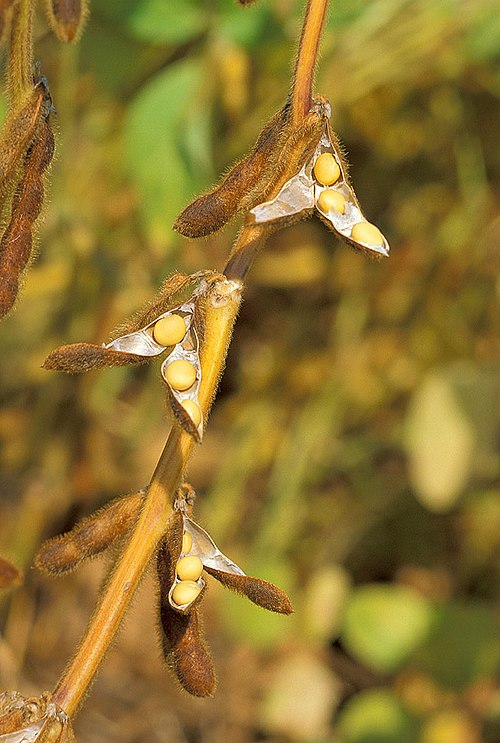
The flowers sit where a leaf joins the stem. In some varieties the stem may stop making nodes once flowering begins. Strains that carry on are called indeterminates, and they suit climates where the growing season is longer. The pods grow in clusters of three to five and are 3 to 8 cm long. Often the leaves drop before the seeds are fully mature.[1]
The seeds measure 5 to 11 mm across and vary widely in size and in hull colour: black, brown, yellow or green, and commonly variegated or two-coloured. Black-hulled beans are the ones used for douchi, the fermented black beans of China. Each seed carries a visible scar, the hilum, which may itself be black, brown, buff, grey or yellow.[1]
A hard coat and a talent for drying out
A mature bean has a hard hull that resists water and shields the cotyledon and the hypocotyl, or germ, from damage. A seed with a cracked coat will not germinate. The hilum has the micropyle at one end, a small opening through which water can be absorbed for sprouting.[1]
Soya beans belong to a group of very high-protein seeds that can dry out, survive, and revive once they take up water again. A. Carl Leopold started to study this ability in the mid-1980s at Cornell University's Boyce Thompson Institute for Plant Research. He found a range of soluble carbohydrates in soya beans and corn that protect the viability of the seed's cells. Two sugars in the bean, raffinose and stachyose, guard the seed against desiccation.[1]
Garden beans and field beans
Soya beans fall broadly into two types, vegetable or garden beans and field or oil beans. Compared with field types, the garden ones are larger, cook more easily, taste mild and nutty, and hold more protein and less oil. They are generally unsuited to combine harvesting, because their pods tend to shatter when they reach maturity.[1]
The bean should not be eaten raw. Raw soya beans, the immature green ones included, are toxic to all monogastric animals, and for people they must first be cooked, roasted or fermented. In the Japanese dish edamame, immature beans are boiled whole in the pod and served with salt.[1]
A nematode and a single line of defence
In the United States the plant's worst pest is the soybean cyst nematode, which commonly takes 30% or 40% of a crop even where no symptoms show. The vast majority of American cultivars resist it, but they depend on one breeding line, PI 88788, as the only source of that resistance. Of 849 cultivars counted in 2020, 810 had some PI 88788 ancestry. By then this was clearly producing nematode populations that are virulent on the line.[1]
Classification
- Rank
- species
- Family
- Fabaceae
- Genus
- Glycine
- Also known as
- Dolichos sofa, Glycine angustifolia, Glycine formosa, Glycine javanica, Glycine mas, Phalseolus max, Phaseolus max, Phaseolus sordidus, Soja max
Names around the world
- English
- Soya-Bean, Soyabean, Soybean, edamame, reseeding soybean, soy, soya, soybean
- Afrikaans
- Sojaboon
- Arabic
- فول الصويا
- Armenian
- Սոյա
- Bangla
- সয়াবিন
- Basque
- Soja
- Bulgarian
- Соя
- Chinese
- da dou, 大豆, 大豆根, 大豆黄卷, 枝豆, 毛豆, 淡豆豉, 穞豆
- Czech
- sója, sója luštinatá
- Danish
- Sojabønne, Soyabønne
- Dutch
- Sojaboon
- Esperanto
- Sojfabo
- Esperanto
- Sojfabo
- Estonian
- karvane sojauba
- Filipino
- Balatong
- Finnish
- Soijapapu, peltosoijapapu, soijapapu
- French
- Soja, Soja protéagineux, Soja, Soja élevé
- Galician
- Soia
- German
- Sojabohne
- Greek
- σόγια
Pests and pathogens recorded on it
What Wikidata links to this plant and Wikipedia files as a plant pest or pathogen. The list is not complete, and says nothing about how serious or how widespread each is.
Farmed worldwide
World production, area and yield by year and by country:
References
The article above is written by GrowEarth. Its facts were checked against these sources; the wording is our own.
- Soybean (revision of 10 November 2026). Wikipedia, the free encyclopedia. Accessed .
Sources and licenses
- GBIF Backbone Taxonomy: GBIF Secretariat (2023). GBIF Backbone Taxonomy. Checklist dataset https://doi.org/10.15468/39omei accessed via GBIF.org on 2026-11-16. License: CC-BY-4.0.
- Wikidata: Wikidata contributors. Structured data from Wikidata is available under CC0 1.0. License: CC0-1.0.
- Wikimedia Commons: Images from Wikimedia Commons. Each file carries its own license and credit, shown with the image. License: per-record.
- Wikipedia (English): Text from Wikipedia, the free encyclopedia, by its contributors, under CC BY-SA. Excerpts are shortened; follow the link for the full article and its history. License: CC-BY-SA-4.0 (share-alike).