Punica granatum · Lythraceae
Pomegranate: the seeded apple of the Iranian plateau
A spiny shrub from the lands between the Caucasus and Pakistan bears a berry holding hundreds of seeds, and one culture after another has made it a symbol.
3 min read · Reviewed · 1 reference
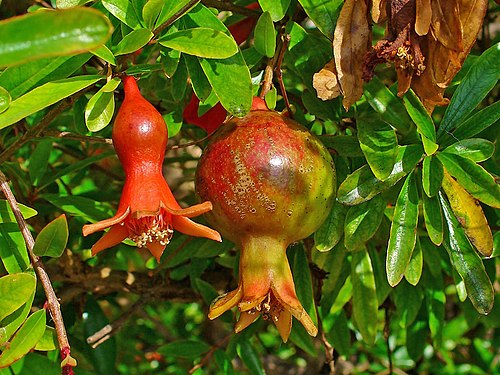
An apple full of seeds
The English name comes from Old French pomme-grenade, itself from the medieval Latin words for apple and seeded. The same Old French word gave modern French grenade, the namesake of the military grenade, and the gem name garnet, by way of the dark red colour of the fruit's pulp. In Ireland pomegranates were colloquially called wineapples, a term that survives only in a few pockets.[1]
A spiny shrub that can live two centuries
The pomegranate, Punica granatum, is a deciduous shrub or small tree in the family Lythraceae. It grows 1.5 to 5 metres high and has multiple spiny branches. The leaves are glossy and narrowly oblong, up to 5 centimetres long. It is long-lived: some specimens in France have survived for 200 years, and mature plants can develop twisted, sculptural bark and several trunks.[1]
The flowers are bright red or white, 3 centimetres or more across, with three to seven petals. Their pollinators are bumblebees, carpenter ants, lemon butterflies and both Eastern and Western honey bees. Some cultivars set no fruit at all and are grown for the blossom alone.[1]
Inside the husk
Botanically the fruit is a berry, formed from the ovary of a single flower. A hard red-purple outer layer covers a spongy white inner wall, and membranes divide the inside into uneven chambers that hold the seeds. Each seed wears a thick, fleshy coat, the sarcotesta, and a fruit can hold anywhere from 200 to about 1,400 of them. Wild fruit measures 2 to 8 centimetres across; some cultivars reach 12.[1]
The juice pressed from the seeds of mature fruit is tart, with a pH of 4.4 and a high content of polyphenols, and it may leave an indelible red stain on fabric. Its colour comes mainly from anthocyanins and ellagitannins. The only other species in the genus, the Socotran pomegranate, Punica protopunica, has pink flowers and smaller, less sweet fruit, and is found only on the Socotran archipelago in the Arabian Sea.[1]
Out of Iran
The pomegranate originated in a region spanning the Caucasus and the Iranian plateau, including present-day Iran, Turkmenistan and Afghanistan, and reaching down to Pakistan, where it grows wild between 1,000 and 2,000 metres. Ancient Iranians were the first to domesticate it, on the Iranian plateau and in nearby regions. From there it was taken across the Middle East, to Turkey and India, and to parts of Africa and Europe.[1]
Archaeology picks up the trail early. Gezer in Israel has yielded remains of the fruit from the Neolithic, and early Bronze Age levels at Jericho have yielded carbonised husk. Waterlogged remains lay in the Uluburun shipwreck off the Turkish coast, from around the 14th century BC, beside perfume, ivory and gold jewellery, which suggests the fruit may then have been considered a luxury.[1]
In the late 16th century it reached Spanish America, and California, with Spanish settlers, in 1769. John Tradescant the Elder brought it to England in the 17th century, where it did not set fruit, and in 1771 Thomas Jefferson put pomegranates in the ground at Monticello.[1]
Drought, frost and five hundred names
Pomegranates tolerate drought and can be grown in dry areas, whether the rain falls in winter, as in a Mediterranean climate, or in summer. In wetter places fungal diseases can rot the roots. The plants stand moderate frost, down to about −12 °C. There are more than 500 named cultivars, though with considerable synonymy: one genotype goes by different names in different parts of the world. A dwarf variety, Punica granatum var. nana, is popular in gardens and larger containers and as a bonsai.[1]
Before the tomato
Before tomatoes arrived in West Asia, Iranian cooking made wide use of pomegranate juice, pomegranate molasses and vinegar. The mixture survives in fesenjān, a thick sauce of pomegranate juice and ground walnuts served most often over duck or other poultry with rice. Grenadine syrup, common in cocktails, was originally thickened, sweetened pomegranate juice, and in the carpet industry the peel may serve to stain wool and silk.[1]
A fruit of many meanings
In ancient Persia the pomegranate, and especially its blossom, was sacred and symbolic, linked with fertility, abundance and royal authority; a petroglyph at Persepolis shows an Achaemenian king holding a pomegranate flower. In Greek mythology it was the 'fruit of the dead', and the seeds Persephone ate oblige her to pass a certain number of months of each year in the underworld.[1]
The Hebrew Bible lists it among the Seven Species, the special products of the Land of Israel, and it is eaten on Rosh Hashanah. A popular tradition gives the fruit 613 seeds, one for each commandment, though the figure does not appear in rabbinic sources. The Quran mentions it, Armenia treats it as a symbol of fertility, abundance and marriage, and in China, where it arrived during the Han dynasty, pictures of the ripe fruit bursting with seeds were hung in homes.[1]
Classification
- Rank
- species
- Family
- Lythraceae
- Genus
- Punica
- Also known as
- Granatum punicum, Punica florida, Punica granatum acidula, Punica granatum alba, Punica granatum albescens, Punica granatum flava, Punica granatum flavescens, Punica granatum frutescens, Punica granatum granatum, Punica granatum legrelliae
Names around the world
- English
- Pomegranate, Pomegranate Tree, pomegranate
- Afrikaans
- granaat
- Arabic
- الرمان, رمان
- Aragonese
- Minglanera
- Armenian
- Nur
- Asturian
- almingranal
- Bangla
- বেদানা
- Belarusian
- Гранат звычайны
- Catalan
- Magraner
- Chamorro
- Granåda
- Chinese
- shi liu, 丹若, 安石榴, 山力叶, 甜石榴, 白石榴, 白石榴根, 白石榴花
- Croatian
- Mogranj, Nar, Šipak
- Czech
- granátové jablko, marhaník granátový, marhaník obecný
- Danish
- Granatæble
- Dutch
- Granaatappel, granaatappel
- Esperanto
- Granato
- Esperanto
- Granato
- Estonian
- harilik granaadipuu
- Finnish
- Granaattiomena, granaattiomena
- French
- Grenadier, Grenadier commun, Grenadier commun, Grenade, Grenadier commun, Grenadier, Grenadier, Grenadier commun, Grenadier à graines nombreuses, grenade, grenadier commun
Pests and pathogens recorded on it
What Wikidata links to this plant and Wikipedia files as a plant pest or pathogen. The list is not complete, and says nothing about how serious or how widespread each is.
References
The article above is written by GrowEarth. Its facts were checked against these sources; the wording is our own.
- Pomegranate (revision of 12 November 2026). Wikipedia, the free encyclopedia. Accessed .
Sources and licenses
- GBIF Backbone Taxonomy: GBIF Secretariat (2023). GBIF Backbone Taxonomy. Checklist dataset https://doi.org/10.15468/39omei accessed via GBIF.org on 2026-11-16. License: CC-BY-4.0.
- Wikidata: Wikidata contributors. Structured data from Wikidata is available under CC0 1.0. License: CC0-1.0.
- Wikimedia Commons: Images from Wikimedia Commons. Each file carries its own license and credit, shown with the image. License: per-record.
- Wikipedia (English): Text from Wikipedia, the free encyclopedia, by its contributors, under CC BY-SA. Excerpts are shortened; follow the link for the full article and its history. License: CC-BY-SA-4.0 (share-alike).